Go to main content
Professionals (EN) Private (EN/DA) Asylum (EN/DA) Integration (DA) Volunteers (DA) Shop (DA)
Danish Refugee Council
Donate
News

Meet Abu Khaled - Where the Seashells Meet the Dust of War

Posted on 30 Dec 2025

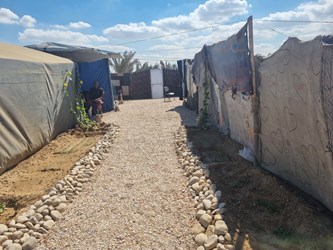
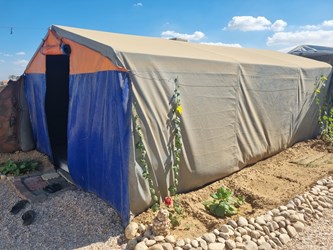
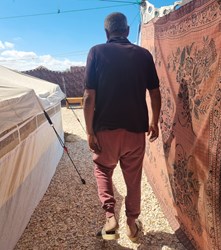
Jamal Qishta, known as Abu Khaled, is a 56-year-old carpenter from the Brazil neighborhood in Rafah. Before the war, he lived with his wife and five children in a home he spent decades building, stone by stone. Today, he lives in a tent in Al Noor Site in Mawasi Rafah, side by side with his brother who was displaced from Gaza City. Their two tents sit only meters apart, and the two families support each other like one household; sharing food, tools, labour and hope. His hands once crafted furniture and carved wood; now they hold fabric and rope against winter winds, plant flowers beside a tent wall, and lay seashells under bare feet to keep out the mud. Where a home once stood, a shelter stands, held up by work, memory, and will. 

Jamal speaks with a voice that carries both strength and sadness: “I’ve been running from one place to another like a tree without roots. Every time I try to rest, the ground moves again under me,” says Jamal after being displaced six times. 

When the first ceasefire came, Jamal returned to Rafah hoping to find home again, but what he found was ruin. “When I saw Rafah, I couldn’t recognize her. The streets I grew up in were buried in dust. The smell of gunpowder and death was everywhere. My home, my dreams, my life .. all buried under the stones I built with my own hands.” 

He had spent decades saving and working to build that house. “I built it stone by stone. Every corner of it had a memory. But this is life. At least we are alive.” 

During the short ceasefire, Jamal lived in a small tent next to the ruins of his home. He refused to leave, clinging to hope that peace might last. “Everyone came to see their destroyed houses and left. But I stayed. I wanted to feel near my home.. even if I was living under a tent.” When the ceasefire collapsed, chaos returned. “People were running in the streets like madness. Shells falling, bullets everywhere. I wanted to stay near my house, but I had to run to save my family.” 

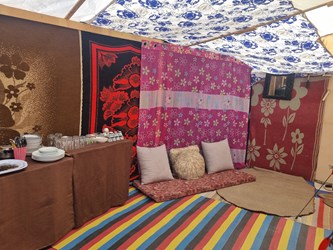
He moved to Mawasi Khan Younis for several months. As a carpenter, he used his skills to build a simple but beautiful tent for his family. “I tried to make it feel like home. I used what I found.. wood, cloth, and hope.” 

Yet life there became impossible, crowded, unsafe, and full of fear. So he returned to Rafah and settled in Al Noor Site, near his brother. “Here I feel peace, even with the bombing. There’s magic in the air of Rafah. It hurts me, but it’s still home.” 

Basic Needs and Daily Life 

Jamal and his brother now live like one family, sharing food, tools, and hope. Their two tents stand side by side.. a small circle of life in a sea of displacement. 

“We help each other. When my brother has nothing to cook, I share what I have. When I feel tired, he encourages me. That’s how we survive together.” 

He built a solid floor of seashells to keep the mud away, planted flowers and small trees, and made a kitchen with his own hands. Next to the tent, he created a small play area for his children and a wooden gate to mark their space. 

“I miss my house. The place where my children grew up. I feel the pain of losing it every day. But I will rebuild. Even if it starts with a flower beside a tent.” 

Their access to food and water remains limited. Jamal says his main goal now is to keep his family safe and preserve some sense of normal life. 

“People think hope dies when your house is destroyed. No .. it dies when you stop planting something green.” 

DRC site management in Gaza

Around 600,000 people live in displacement sites across Gaza and more than a million live outside formal sites, with thousands of tents already flooded or collapsed after the first serious rains.

Thanks to a hybrid partnership model, DRC and its partners reach the hardest-to access communities across more than 42 sites, providing area based integrated, life-saving assistance and maintaining continuity of basic services:

  • Site mapping, service coordination, and area based outreach and coordination to ensure coverage in underserved sites.
  • Implement rapid site improvements to support both Disaster Risk Reduction (DRR) and winterisation preparedness
  • Conduct participatory planning for site upgrades and returns pathways.

Facing another winter

When asked about the previous winter, Jamal sighed. “The rain used to be a blessing. Now it’s a threat. When it rains, the tent shakes and the ground turns to mud. We hold the poles so it doesn’t collapse.” 

He remembers the cold nights and sickness among his children. “We had no blankets left. We burned wood and even old clothes to stay warm. My kids cough all night.” 

This year, he tries to prepare as much as he can, adding extra plastic sheets, raising the floor with shells and wood, and collecting stones to keep the water out. “I can’t stop the rain, but I can make the ground a bit stronger. That’s what I do. I build, even when everything falls apart.” 

Winterization response

Since November heavy rains caused severe flooding across displacement camps; thousands of tents were inundated or collapsed, destroying bedding and clothing just as winter started. 

In November 2025, through ongoing coordination efforts, DRC also secured 160 new tents distributed on 17 November as part of the winterization response. These tents will support households severely affected by the recent winter storm, with priority given to the most vulnerable families currently exposed to harsh weather conditions. Additionally, DRC’s partner PARC plans to distribute additional 602 tents across five sites located along the seashore and in remote areas, targeting highly vulnerable households displaced from the north as well as families already living in coastal sites. In parallel, DRC partners have completed Winterization Response works in six sites in southern Mawasi, using sandbags to reduce flood risks and reinforcing slopes and low-lying areas to prevent water buildup.

We don’t want pity... we want a chance to live, to rebuild, to breathe our own air again.

/  Abu Khaled final message, firm, human, dignified.

Despite all the loss and displacement, Jamal still believes in return and rebuilding. “I feel the pain of losing my home every day, but I also feel the love for this land. I was born in Rafah and I will die here.” 

He looks toward his small garden and smiles gently. “There is magic in the air of Rafah. Even the dust here tells you to stand again.” 

What gives him hope is the sound of his children laughing, even in displacement. “My children. When I see them laugh in the yard I made, I know life can begin again.” 

Abu Khaled's tent in Al Noor Site in Mawasi Rafah. He built a solid floor of seashells to keep the mud away, planted flowers and small trees, and made a kitchen with his own hands.

← →
<
30 Dec 2025
Meet Mervat: A Mother Holding Four Daughters Through War and…
>
30 Dec 2025
Meet Abu Osama — The Long Journey of Displacement From Jabal…