
Sahel: Protection Analysis from Project 21
4 file(s)
Co-hosted by DRC and UNHCR, Project 21 is an inter-agency protection monitoring system that gathers and analyses community-based protection data across the Sahel and beyond.

Communities in the Sahel+ region face a deepening protection crisis, driven by food insecurity, forced displacement, and movement restrictions, aggravated by armed conflict. Without timely, evidence-based actions, the situation will further deteriorate.
Project 21 provides the data and analysis needed to guide effective, protection-centered responses. Through regular interviews and joint analysis, Project 21 identifies key risks and emerging trends to inform more effective responses, improve coordination, guide advocacy, and address the needs of both displaced and host communities.
Through coherent datasets and joint analyses across the region, we support humanitarian, development, and peace actors to effectively address protection risks and needs of the affected populations in the Sahel+ region.
/ Project 21
Project 21 is a cross-border, inter-agency and regional protection monitoring system. With standardized methodology and harmonized tools, we transform voices of communities affected by displacement, insecurity, and conflict, into informed actions, strategies, and programs.
Project 21 is co-hosted by DRC and UNHCR. We partner with 30+ organizations (20+ local and national ones) to collect, analyze, and disseminate protection data. You can find a list of partners on our website.
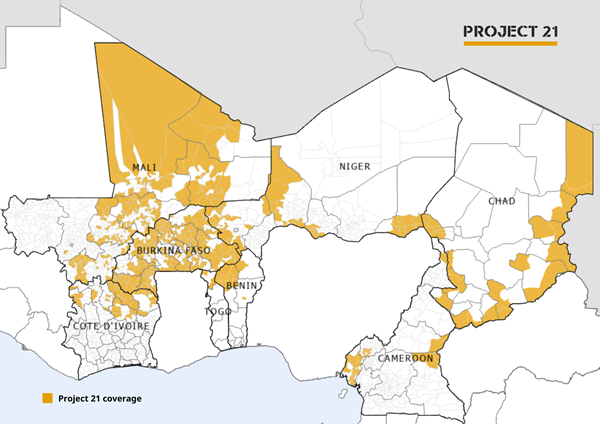
The regional team of Project 21 is based in Dakar, Senegal. The national teams include Benin, Burkina Faso, Cameroon, Central African Republic, Chad, Côte d’Ivoire, Mali, Niger and Togo. You can find on our website in what regions we operate in those countries.
In areas affected by insecurity, the volatile context and dynamics of forced displacement create major challenges for humanitarian actors, particularly in collecting reliable data. Project 21 was established to address these gaps in protection data and analysis.
We operate in most areas affected by forced displacement, as prioritized by the Global Protection Cluster, based on the severity of protection risks and the operational capacity of data collection partners. Using an adaptable and context-sensitive methodology, Project 21 applies a two-stage stratified cluster sampling to identify localities within targeted administrative zones, followed by a random walk approach to select households for interviews.
This flexible approach allows Project 21 to collect large volumes of diverse, regular data even in hard-to-reach areas where few other reliable sources exist. These data enable the analysis of how crises affect the protection environment of displaced and host populations.
By harmonizing tools and coordinating trained partners across different operational contexts, Project 21 ensures that data collection follows common standards—making results comparable, credible, and actionable across the Sahel and beyond.
4 file(s)

Xiang
Sicong
Project 21 Advocacy Specialist

Christian
Sambou
Project 21 Protection Coordinator

Ibrahima
Sagne
Project 21 Information Management Coordinator